Services
Hypnotherapy
Hypnotherapy at Studio Somnus works with the scientific understanding that much of human behavior is shaped by processes beneath conscious awareness. Through guided hypnosis, attention gently shifts inward, allowing the deeper layers of the psyche to become accessible.
In a calm and receptive hypnotic state, patterns of emotion, memory, and belief can be explored and gradually reshaped. The work is quiet, focused, and individually tailored.
Clients often seek hypnotherapy for:
persistent stress or anxiety
sleep disturbance or mental restlessness
creative or professional blocks
performance pressure
periods of psychological transition
releasing entrenched habits or limiting beliefs
The process is restorative and transformative, allowing new perspectives and inner resources to emerge naturally.
Depth Dialogue
Depth Dialogue is both a foundational entry point and a premium offering at Studio Somnus—an inquiry-led immersion that moves beyond surface-level understanding. By integrating hypnotherapy, lucid liminal meditation, and bibliotherapy, it creates a direct and efficient pathway into deeper layers of insight.
Rather than a conventional consultation, it is a structured descent into the quiet architecture of your inner world. Within this space, diffuse thoughts begin to organize, and what feels unresolved becomes more clearly articulated. The process gently moves beyond habitual analysis, allowing deeper patterns and perspectives to emerge with clarity.
Sought out during:
The Threshold — transition without clear direction
The Plateau — reflection that no longer moves
The Labyrinth — complex relational dynamics
The Stillness — stagnation calling for realignment
The Core — deeper existential inquiry
From this clarity, direction does not need to be forced - it arises naturally, recognized rather than constructed.
Lucid Liminal Meditation
Some periods in a life do not yield to analysis. Lucid liminal meditation is a contemplative encounter shaped for those thresholds — a session in which I, and not the client, enter a sustained meditative state while remaining fully present in conversation.
The state can be compared to Mongolian throat singing, where two tones are held at once. One tone of awareness stays attentive to the present exchange; the other enters a liminal field in which symbolic impressions arise. From this dual attention, patterns connected to the client's situation may become perceptible and are offered as reflections rather than conclusions.
Language is used sparingly, and silence is kept where it carries meaning. What emerges arrives as image, felt impression, or recurring theme rather than as explanation — and what is made of it remains the client's own.
Clients often engage this modality when they seek:
clarity at a threshold, when direction has not yet taken form
perspective on a complex personal or professional decision
insight into relational or emotional dynamics
reflection when rational analysis has reached its limit
No intake precedes the session. Each encounter begins unframed, so that perception may arrive without expectation.
This work is contemplative and non-clinical. It offers no diagnosis and replaces no medical or psychological care.

Bibliotherapy
Bibliotherapy explores the symbolic dimensions of the psyche through literature.
Literature gives form to emotional realities that often elude direct articulation. Through carefully curated texts, inner experience is encountered at a reflective distance, where perception can soften and reorganize. Contemporary psychology suggests that such encounters engage the mind’s natural capacities for empathy and cognitive flexibility, allowing new patterns of understanding to emerge.
Sessions are offered for individuals or small, private constellations of up to three participants, such as friends, family, or colleagues. Following a session request, clients are invited to complete a brief intake form. This initial reflection allows a text (or a small selection of texts) to be thoughtfully curated and shared in advance.
Bibliotherapy is especially suited for:
navigating questions of mortality, grief, and loss
giving form to complex emotional states, including depression and bipolarity
integrating identity and meaning during periods of transition
loosening patterns of psychological stagnation
cultivating symbolic insight where analysis alone feels insufficient
Each session stands as a complete encounter, while also allowing a deeper process to unfold over time.
Approach
The work of Studio Somnus is grounded in three complementary ways of understanding the human mind:
Science · Symbol · Psyche
Science offers empirical insight into how the mind functions
Symbol reveals the language through which the psyche expresses itself.
Psyche refers to the living interior landscape where experience, memory, and imagination meet.
Hypnotherapy works primarily through the scientific understanding of the subconscious mind.
Lucid liminal meditation engages the intuitive perception of psychological patterns.
Bibliotherapy explores the symbolic narratives through which human experience becomes meaningful.
Depth dialogue integrates all these modalities into an immersive and effective pathway toward restoration.
Together, these therapeutic modalities form a coherent method of reflection and transformation. Each modality enters the mind from a different doorway, yet all ultimately meet within the same field of experience.
How Sessions Work
At Studio Somnus, every engagement is crafted to ensure a seamless transition from the initial inquiry to deep, transformative work. Our workflows are designed with discretion and precision, honoring the unique nature of each therapeutic modality.
Private Individual Engagements
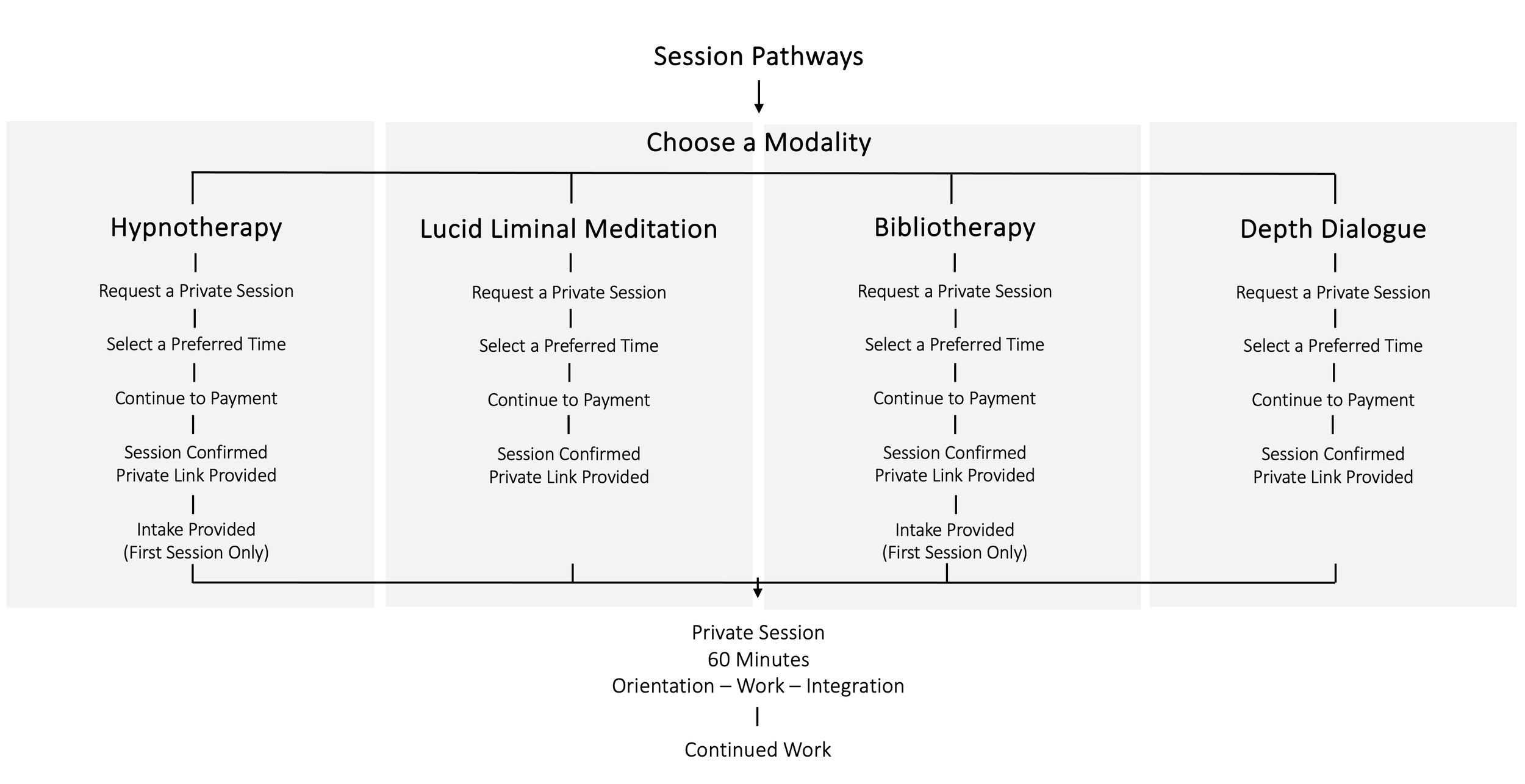
Individual sessions are generally structured as 60-minute immersive experiences, encompassing a dedicated orientation phase, the core therapeutic work, and a period for conscious integration.
Reservation: Clients select a preferred time through the private reservation portal.
Confirmation: The engagement is secured upon completion of the payment process.
Access: A bespoke, encrypted link is provided to ensure a secure and private digital environment.
Preparation:
Hypnotherapy & Bibliotherapy: New clients are invited to complete a brief intake reflection prior to the inaugural session to align our focus.
Lucid Liminal Meditation & Depth Dialogue: These sessions begin without prior assessment, allowing the experience to unfold organically and with clarity.
Modalities and Continuity
Digital Sanctuary: Most sessions are conducted via secure live video, providing the convenience of professional continuity regardless of your location.
Bespoke Arrangements: While the primary work is digital, in-person engagements may be coordinated upon specific request to accommodate unique circumstances.
Continued Growth: Following the initial experience, clients may choose to deepen their work through ongoing sessions within their chosen modality.
About Christiaan
Studio Somnus was founded as a quiet threshold where psychological insight, contemplative attention, and the symbolic power of literature converge.
Over the course of my work, I became increasingly attentive to a quieter process beneath analysis and explanation. Insight alone seldom transforms a life. Change more often appears when perception, emotion, and imagination begin to resonate with one another. The studio itself emerged from this intuition: a moment of alignment in which scholarship, contemplative practice, and future vision began to align.
Underlying hypnotherapy, lucid liminal meditation, and bibliotherapy at Studio Somnus is a simple philosophical intuition: that human experience unfolds through patterns of resonance and dissonance. Thoughts and emotions carry tonal qualities that shape how we perceive ourselves and how the world echoes those tones. When these elements harmonize, life gathers coherence; when they clash, experience falls into discord. In this sense, resonance creates alignment between the present and the possible.

Reflections
Reflections are shared here as individual impressions. They describe how particular clients experienced the work in their own understanding. Language has been lightly edited for clarity and to preserve anonymity.
Hypnotherapy
As a foreigner working in the U.S., I often felt like I had to push myself twice as hard to keep up professionally, and that pressure lived in my body all the time. So, I sought hypnotherapy to deal with my anxiety and chronic stress. Hypnosis was something completely new to me, but after a few sessions, I noticed a real shift. My nervous system finally started to calm down. Work situations that used to trigger immediate tension became easier to handle, and I stopped carrying that constant tightness in my chest and shoulders.
Business Consultant — United States
I was grieving a profound loss. The hypnotherapy helped me find enough calm to face what I was feeling instead of trying to hold it all together. Alongside that, Christiaan recommended we read two short stories about characters dealing with grief. Reading and talking about them in that setting affected me more deeply than I expected. Seeing those experiences reflected in literature made me feel less alone, and over time, I felt my grief become something I could carry rather than something that overwhelmed me.
Mother — South Africa
Lucid Liminal Meditation
I participated in a lucid liminal meditation with Christiaan during a very sensitive period in my life. What stood out to me was how accurately he perceived subtle emotional patterns that I hadn't spoken about. Experiencing that level of attunement gave me a strong sense of clarity and reassurance. The session helped me approach an important decision with greater confidence and calm.
Psychologist — United States
As someone who reads widely and has spent time in therapy before, I did not expect bibliotherapy to feel so personal in a group setting. The short stories were remarkably well chosen: unfamiliar titles that somehow spoke directly to questions I had been carrying for years. Several explored themes of mortality, which I had long struggled to face.
The conversations that unfolded each week opened connections to my own life. Hearing how others encountered the same stories was indirectly transformative; through their perspectives, I began to recognize aspects of myself I had not been able to articulate before.
Over the course of the eight weeks, something shifted. The stories, the reflections of the group, and Christiaan’s thoughtful guidance helped me approach difficult questions with greater honesty and acceptance. It was a deeply moving and healing experience.
Actor — United Kingdom
I return for sessions twice per year as a kind of reflective check-in. Working in human resources and psychometric assessment, I am accustomed to careful evaluation, so I approached the first session with curiosity but also some skepticism. Over time, these sessions have become a valuable compass, offering perspective on what may be unfolding beneath the surface and helping me approach both personal and professional decisions with more clarity.
Human Resources Professional — United States
Depth Dialogue
Bibliotherapy
I initially came for hypnotherapy while already receiving psychiatric care and medication for bipolar disorder. We worked on several things during the sessions, but what helped me most was the impact of the bibliotherapy.
We read a short story about a family living with a child who has bipolar disorder. Somehow, it captured the emotional reality of the condition more clearly than anything I had encountered before. I remember telling Christiaan, ‘This story understands my condition better than the DSM.’
That story has stayed with me. It became a kind of anchor: something I return to when I need to make sense of my own experience.
Graduate Student — Japan & United States
